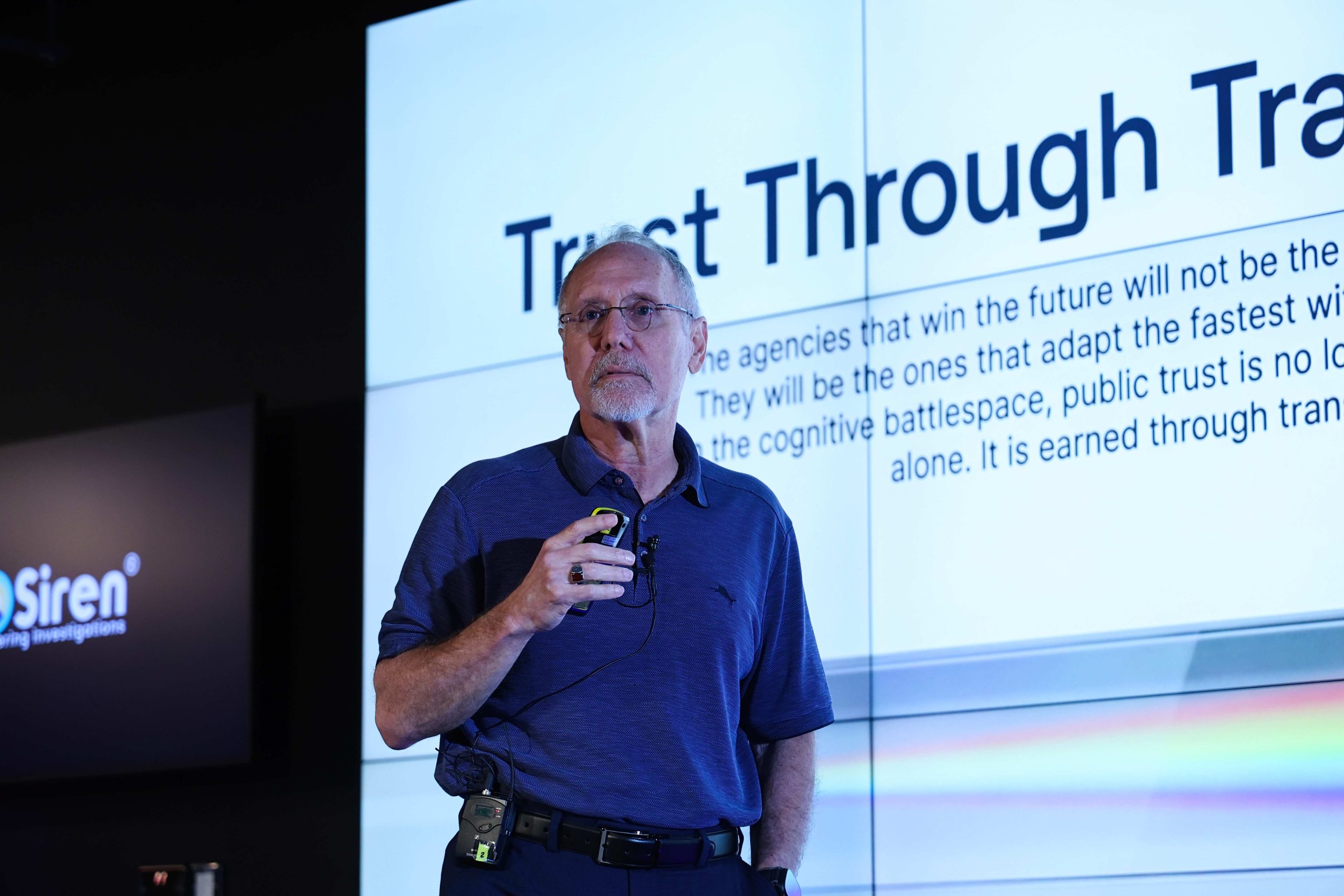
From COPLink to AI: Bob Griffin on the evolution of investigative technology
In this episode of Siren Investigates, Siren CEO John Randles sits down with Bob Griffin, Chairman of Siren, to explore how technology has transformed law enforcement and intelligence over the past three decades.
As a founder and CEO of COPLink and later CEO of i2, Bob helped pioneer the use of connected data in policing, enabling investigators to search information across previously isolated systems and jurisdictions.
Their conversation explores the origins of police data sharing, COPLink’s role in the Montgomery County sniper investigation, the changes that followed 9/11 and why Bob believes artificial intelligence should help investigators make sense of information rather than make decisions for them.
How did COPLink change police technology?
COPLink grew from a fundamental problem facing law enforcement: investigators had access to enormous amounts of information, but much of it existed in separate databases that couldn’t communicate with each other.
A police department could have its record-management system alongside separate databases for gangs, sex offenders, court citations and other specialist information. Bob recalls discovering that the Los Angeles Police Department alone had more than 360 operational databases.
Finding everything connected to one individual could therefore mean searching numerous systems independently.
COPLink was designed to bring these disparate sources together and allow investigators to search and analyse the information collectively. An investigator could begin connecting an individual with their previous police interactions, known associates, addresses, vehicles, weapons and other relevant information.
The concept then expanded beyond individual departments.
If information could be connected within one jurisdiction, it could potentially be connected between neighbouring police departments, across a state and eventually between states.
At its height, Bob says more than 6,000 US jurisdictions were using the COPLink platform.
The result wasn’t simply better access to data. It gave investigators a way to identify relationships and patterns that could remain hidden when information was divided between different systems.
How did 9/11 change information sharing between law enforcement and intelligence agencies?
The September 11 attacks exposed a major weakness in the way information was shared between local, state and federal organisations.
Bob explains that information relating to some of the hijackers existed within state-level systems but wasn’t necessarily available to the federal agencies that needed it.
The problem wasn’t simply that authorities lacked information.
In some cases, the information already existed, but the right people couldn’t access it.
The aftermath of 9/11 accelerated efforts to break down those barriers, including the development of fusion centres designed to improve information sharing across agencies and jurisdictions.
It also highlighted the importance of combining different types of intelligence.
Bob describes analysing the financial activity surrounding the hijackers to understand not only who was connected to whom, but how money moved through the network. Financial transactions provided another layer of information that could help investigators understand how an organisation operated.
The lesson extended far beyond one investigation: data becomes substantially more useful when investigators can connect information across organisational and jurisdictional boundaries.
What role should AI play in law enforcement and intelligence?
Bob makes a clear distinction between two potential uses of artificial intelligence: sensemaking and decision-making.
AI is particularly powerful at sensemaking.
Investigators and intelligence analysts can face enormous quantities of data containing thousands, millions or even billions of potential connections. AI can assist by identifying patterns, amplifying weak signals and surfacing relationships that may otherwise be difficult to detect.
That can also help less experienced analysts recognise patterns that a senior investigator may have learned to identify through years of experience.
But Bob argues that this doesn’t mean AI should make the final decision.
In law enforcement and national security, decisions can have serious consequences. Human judgement and accountability therefore need to remain part of the process.
For Bob, effective investigative AI needs to go beyond simply predicting an outcome. It should also provide justification.
Investigators need to understand how the technology arrived at a conclusion: what information it considered, which relationships it identified and why a particular pattern or recommendation was surfaced.
That transparency is essential to building trust.
The future Bob describes isn’t one in which AI replaces investigators. It’s one where technology helps people work through vastly more information, faster, while the human remains responsible for deciding what to do with it.
Key takeaways
- Connecting previously isolated data sources can reveal relationships that aren’t visible when records are examined independently.
- Information sharing requires more than technology; trust, governance, legal agreements and organisational culture also matter.
- The Montgomery County sniper investigation demonstrated the operational value of analysing information across jurisdictions.
- 9/11 accelerated efforts to improve information sharing between local, state and federal organisations.
- AI can help investigators identify patterns and make sense of enormous datasets, but consequential decisions should remain with people.
- Transparency and justification are essential if investigators are going to trust AI-assisted analysis.
Watch highlights from the episode
‘What Bob Really Liked About i2’